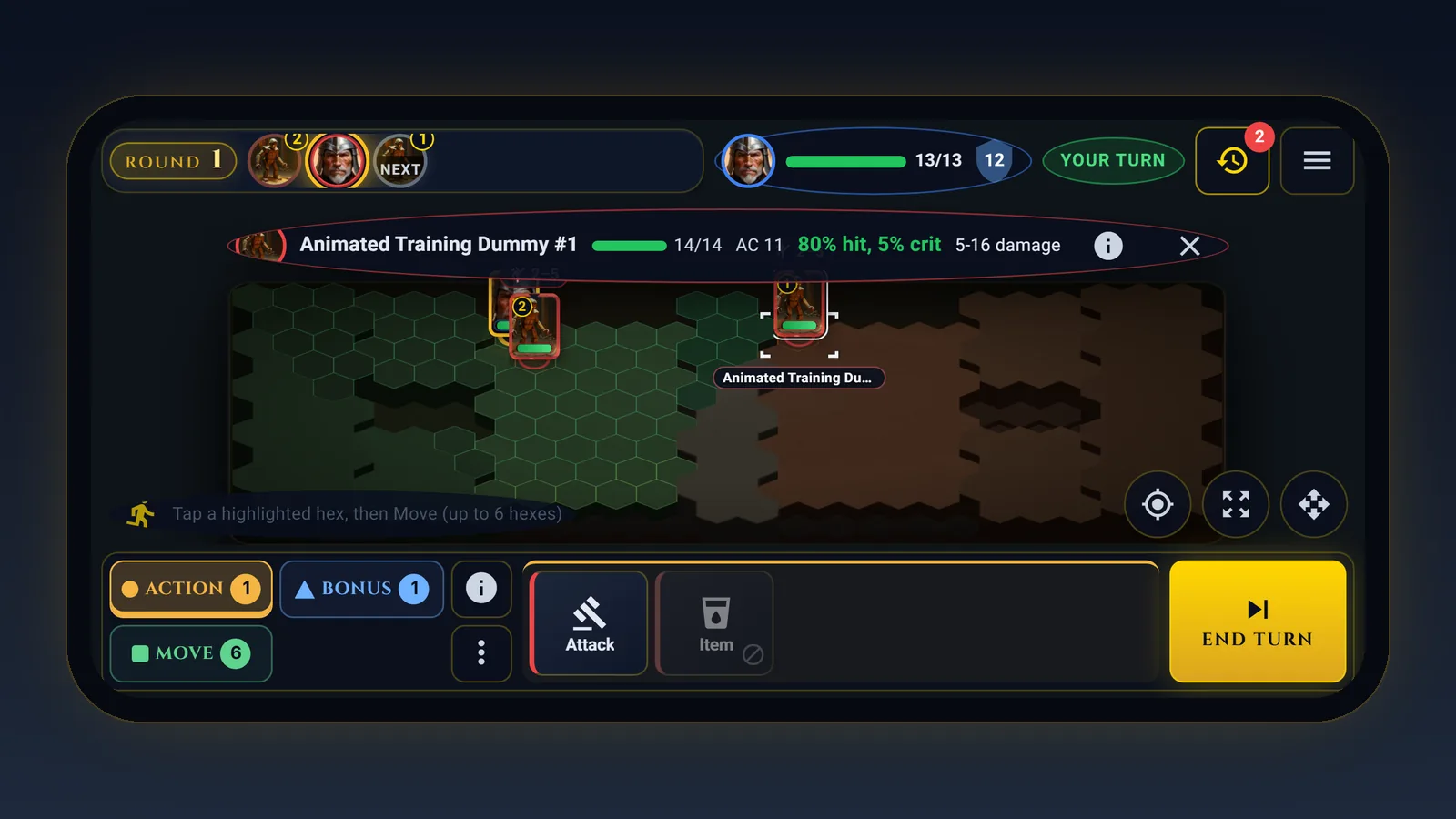
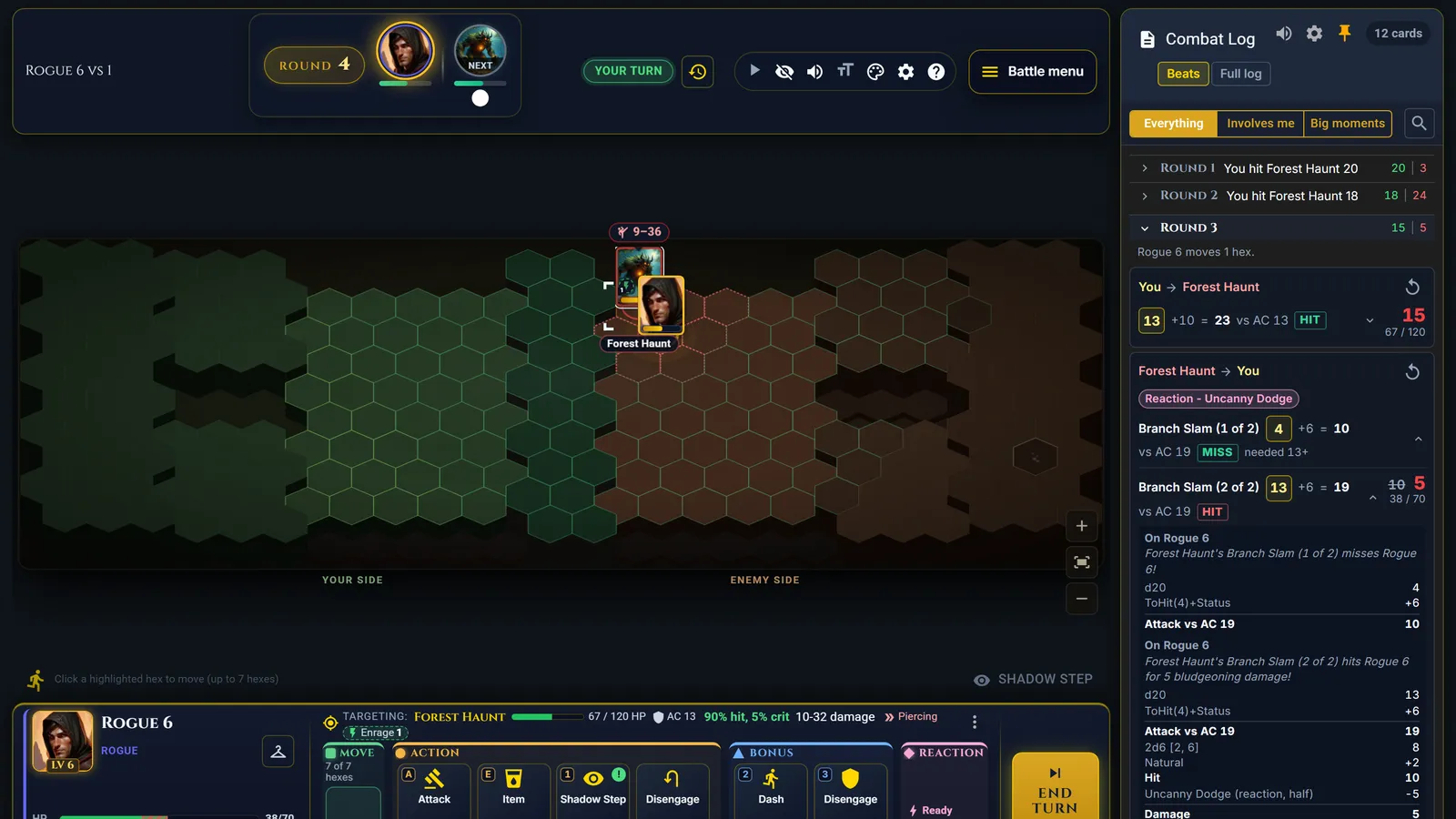
In short: In November 2026 the Lourdin RPG combat log became one card per turn: each roll is one line with the d20, total, AC and a HIT or MISS stamp, a tap opens math that always adds up, and big moments for your hero stand out. After a fight, a battle report says what dropped you, how each round went and how your dice did.
Pull up a chair; this one is for the folk who read the small print. On 11 November 2026 the Lourdin RPG combat log changed shape: one card per turn instead of one row per event, every roll on a single line you can read at a glance, and a tap that opens the math behind it, which always adds up. After the fight, a new battle report tells you what dropped you, how each round went and how your dice really did. Here is each change, and why we made it.
What was wrong with the old combat log?
The old log was a faithful record and a poor companion. It wrote one row per event, so a single Rogue turn could take nine lines: an effect wearing off, a weapon swap, an item card, the Hide headline, its flavor line, the hit you cared about, then three lines of dice. The hit was the sixth thing you read. And:
- Words first, numbers on the right. Your eye zigzagged between a sentence and a row of chips.
- Everything had the same weight. A monster stepping one hex looked just like a critical hit that dropped you.
- Dice math was all or nothing. You showed the breakdown for every row or for none.
- State went missing. After a big hit, nothing told you the monster was down to its last few hit points.
So we split the job in two. The log beside the board answers "what happened this round?" in about five seconds; the battle report answers "what happened, exactly?" for as long as you care to look.
How does a turn card work?
A turn card holds one creature's turn: who acted, an arrow, and who they acted on. Your own hero always reads "You", and names are colored by side: you in gold, allies in white, enemies in red.
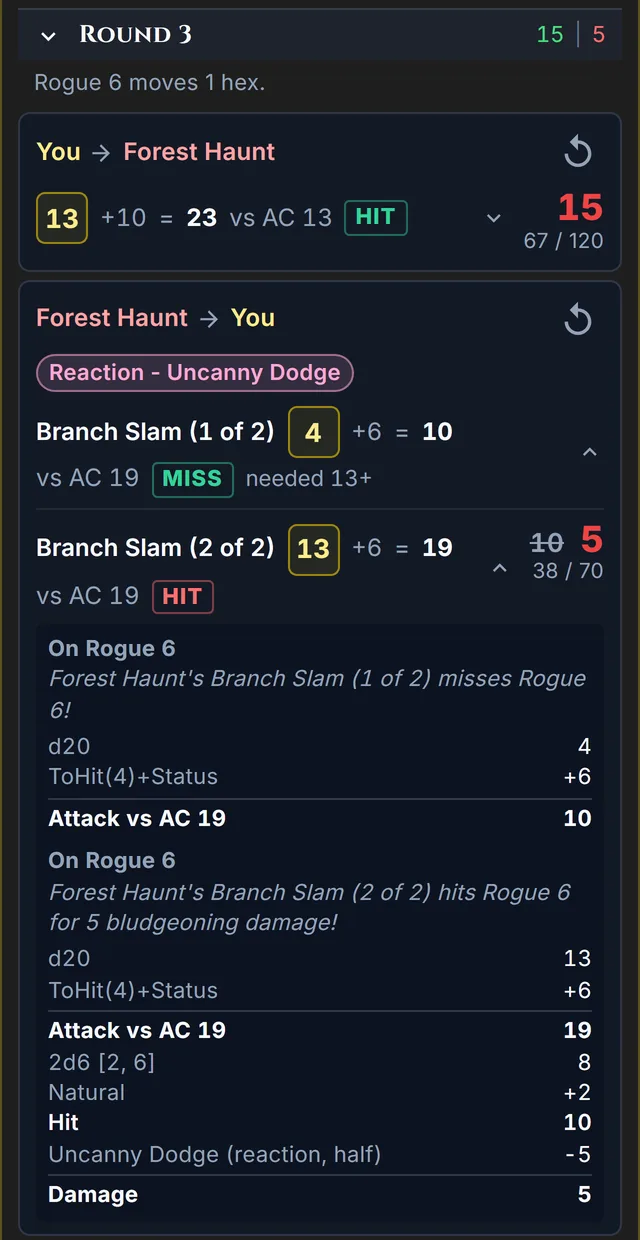
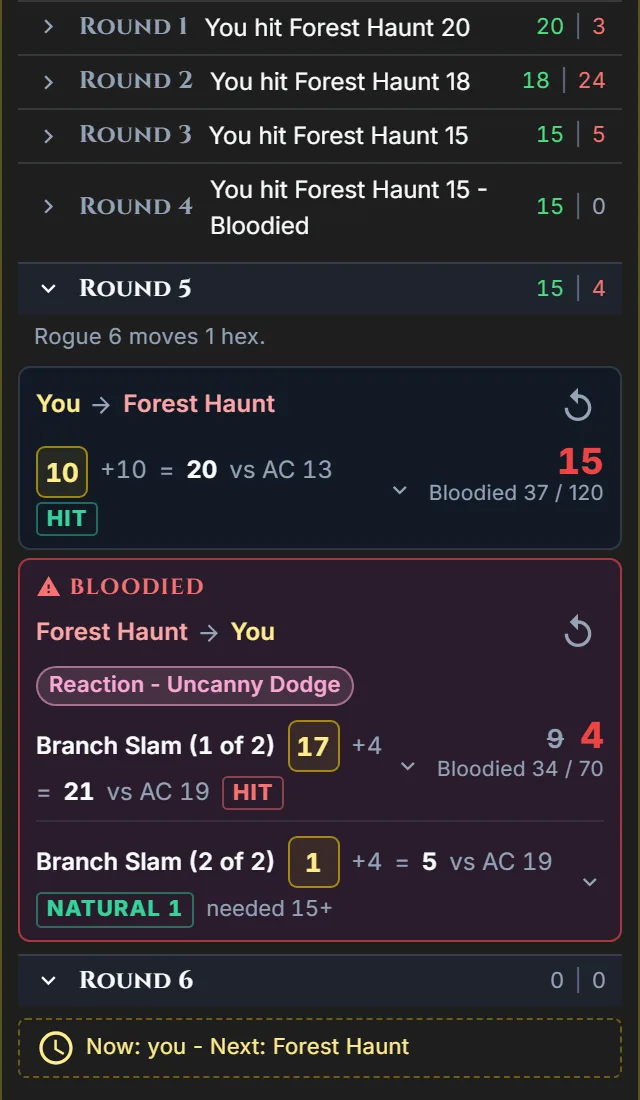
Each roll is one line, read left to right: the action (a monster's attack names its strike, such as "Branch Slam (2 of 2)"), the d20 face, the modifier, the total, the Armor Class or save DC it was against, and a stamp: HIT, MISS, CRITICAL, NATURAL 20 or NATURAL 1, or SAVED and FAILED for a saving throw. The result sits on the right, with the target's health under it. A miss also says what it needed: "needed 13+" is the lowest d20 face that would have hit, the Armor Class minus the attacker's modifier.
The verdict and the roll come first because that is the question you are asking: did it land, and by how much? The game's own sentence is still there for screen readers, as the first line of the math.
Why does the math always add up?
Tap the roll line and the card opens its math: the d20 and its modifier with their source, the attack total against the Armor Class, then the damage dice, each bonus with where it came from, a Hit subtotal, then anything that changed the hit afterwards (a resistance, a Barbarian's Rage, a reaction), then the total. When something lowered a number, the card shows the old value struck through next to the new one, like the 10 that became 5 above.
The rule we held ourselves to is simple: the rows must sum to the total. If the game has not yet recorded where a few points went, the math says "Other reductions" or "Other bonuses" rather than leave a gap you have to puzzle out. An unexplained number is a small lie, and a log that lies once is a log nobody trusts.
How are reactions shown?
A reaction now lives on the card it changed. When a Rogue's Uncanny Dodge halves a hit, the attacker's card wears a "Reaction - Uncanny Dodge" chip, the damage shows its old value struck through, and the math gets an "Uncanny Dodge (reaction, half)" row. When a Bard's Cutting Words takes a few points off an attack roll, the roll line shows the roll as made, the Cutting Words penalty and the roll after it, so you can see exactly how a hit became a miss. Before, a reaction was a separate line above the attack, and the two were easy to read as unrelated.
Which moments stand out?
The log is quiet about most things and loud about a few, and what is loud depends on whose seat you are in. These light up as big cards for your hero:
| Label | When it shows |
|---|---|
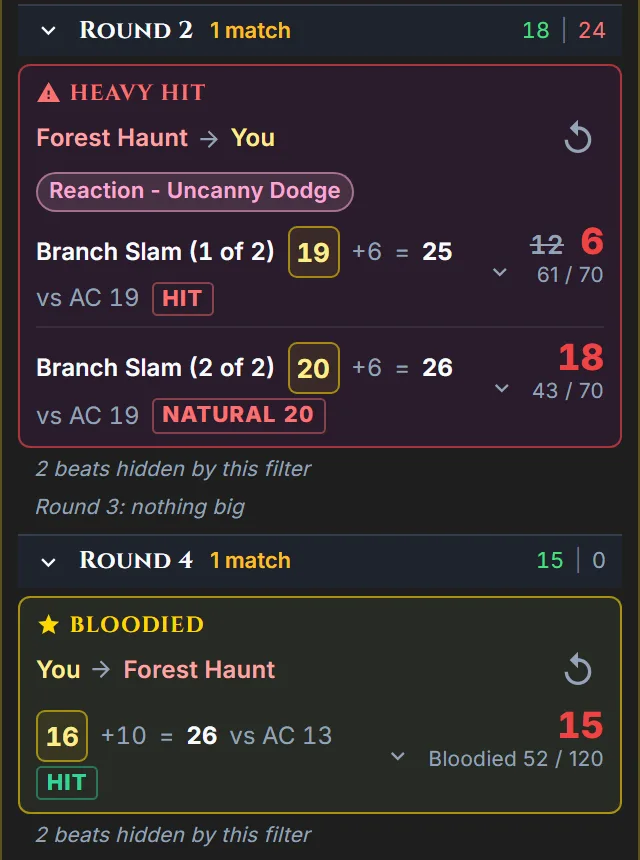
| HEAVY HIT | One blow takes a quarter or more of your maximum HP |
| BLOODIED | A hit takes you to half your maximum HP or below |
| CONDITION ON YOU | A condition lands on you |
| FAILED SAVE | You fail a saving throw |
| DOWN | A hero falls |
Your own critical hits and kills are loud too; when you fight alone, so is every enemy you bloody or fell; and in any fight, a boss bloodied or defeated. A card is red when the moment is bad for your side and gold when it is good. Misses that do not involve you, moves and small notes drop to a single grey line, and runs of them fold into "+2 minor".
In a party fight the rules change on purpose. An ally's critical hit is a small mark on their row, not a loud card, because a log where every friend's good roll shouts at you is a log you stop reading. Only a hero going down, and a boss bloodied or defeated, are loud for every seat.
Three filters sit at the top of the log: Everything (the default), Involves me and Big moments. We kept Everything as the default, in a party too, because hiding your friends' turns makes a co-op fight feel like a solo one.
Why does the last round stay open?
The round you are in is open, and so is the round that just closed. That second part came straight from playtesting: if you act first in a round, the monster's reply comes last, and an early build folded that round away the moment your next turn began. You looked over to see what had just hit you and found it already tucked away.
Older rounds collapse to one line that tells their story from your seat: "You hit Forest Haunt 15 - Bloodied", then two small numbers for the damage dealt and taken that round. The story picks the most important thing for you: you went down, an ally went down, a boss fell or was bloodied, who else fell, then your biggest number. Two or more quiet rounds in a row merge into one line, such as "Rounds 5-6 - no blows landed".
Under the current round, a short line says whose turn it is: "Now: you - Next: Forest Haunt" while you act, or "Up next: you, then Siren" while you wait. A boss's out-of-turn legendary actions get their own card labeled "Legendary", so they never pass for its regular turn.
What is in the battle report?
Open the battle report from the victory screen (a Battle report chip and a Battle report button) or the defeat screen's Battle report button. It has two tabs: Summary and Full log.
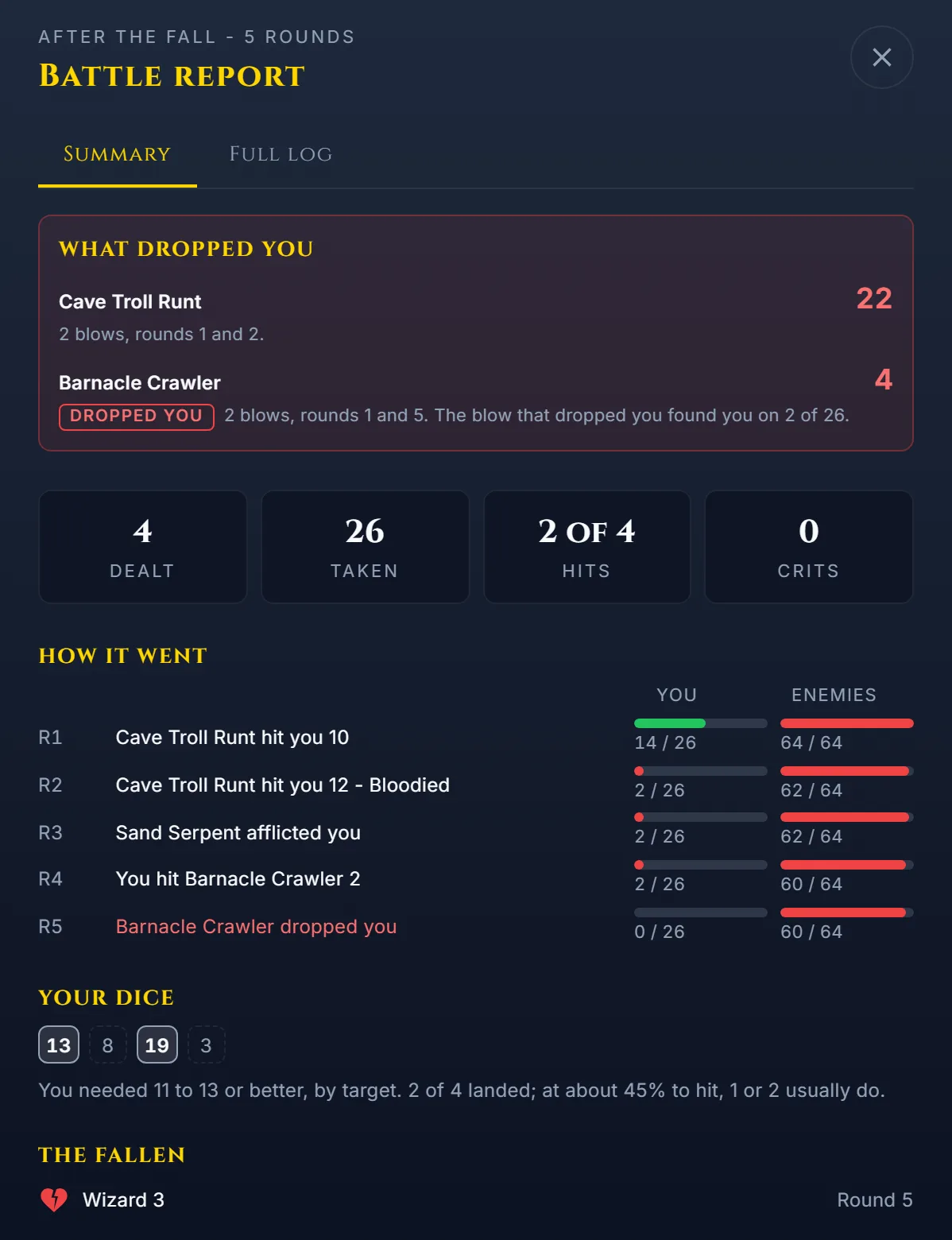
On a defeat, the Summary starts with What dropped you: the damage you took, grouped by source, largest first, with a "Dropped you" tag on the source of the final blow and a plain sentence such as "2 blows, rounds 1 and 5. The blow that dropped you found you on 2 of 26." If an ally's blow hit you, it is listed as "Friendly fire", never under their name.
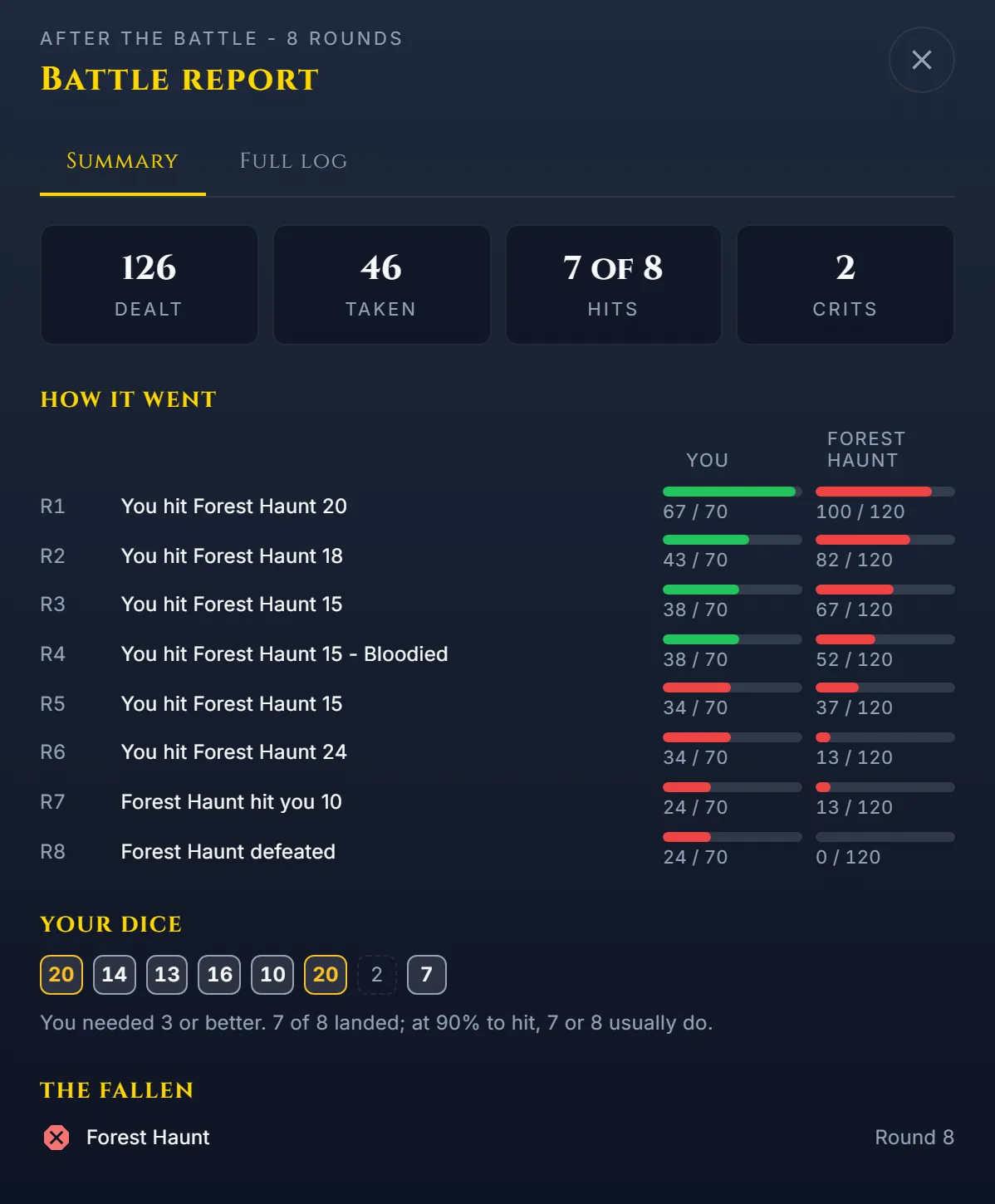
Then four tiles (dealt, taken, hits, crits) and How it went: one line per round, the same story the log tells, with your health and the enemies' health at the end of that round as bars. Each bar is drawn against that side's maximum HP, never against the fight's biggest number, so a bar that looks half empty is half empty.
How does the report judge your dice?
Your dice shows each d20 you rolled to attack, a hit filled and a miss dashed (shape as well as color, so it reads for everyone), a natural 20 in gold and a 1 in red. Then one sentence measures them against what you actually needed: "You needed 3 or better. 7 of 8 landed; at 90% to hit, 7 or 8 usually do." Advantage and disadvantage change the odds it quotes.
An earlier draft compared your rolls to the average d20, 10.5. That says little: against a low Armor Class a 7 is a fine roll. The question after a bad night is "was I unlucky, or was this fight hard?", and the needed number answers it.
A spellcaster who never rolled to attack gets an honest line instead of "0 of 0": the Hits tile counts spells that landed, and the sentence explains that a spell calling for a save rolls the target's die, not yours.
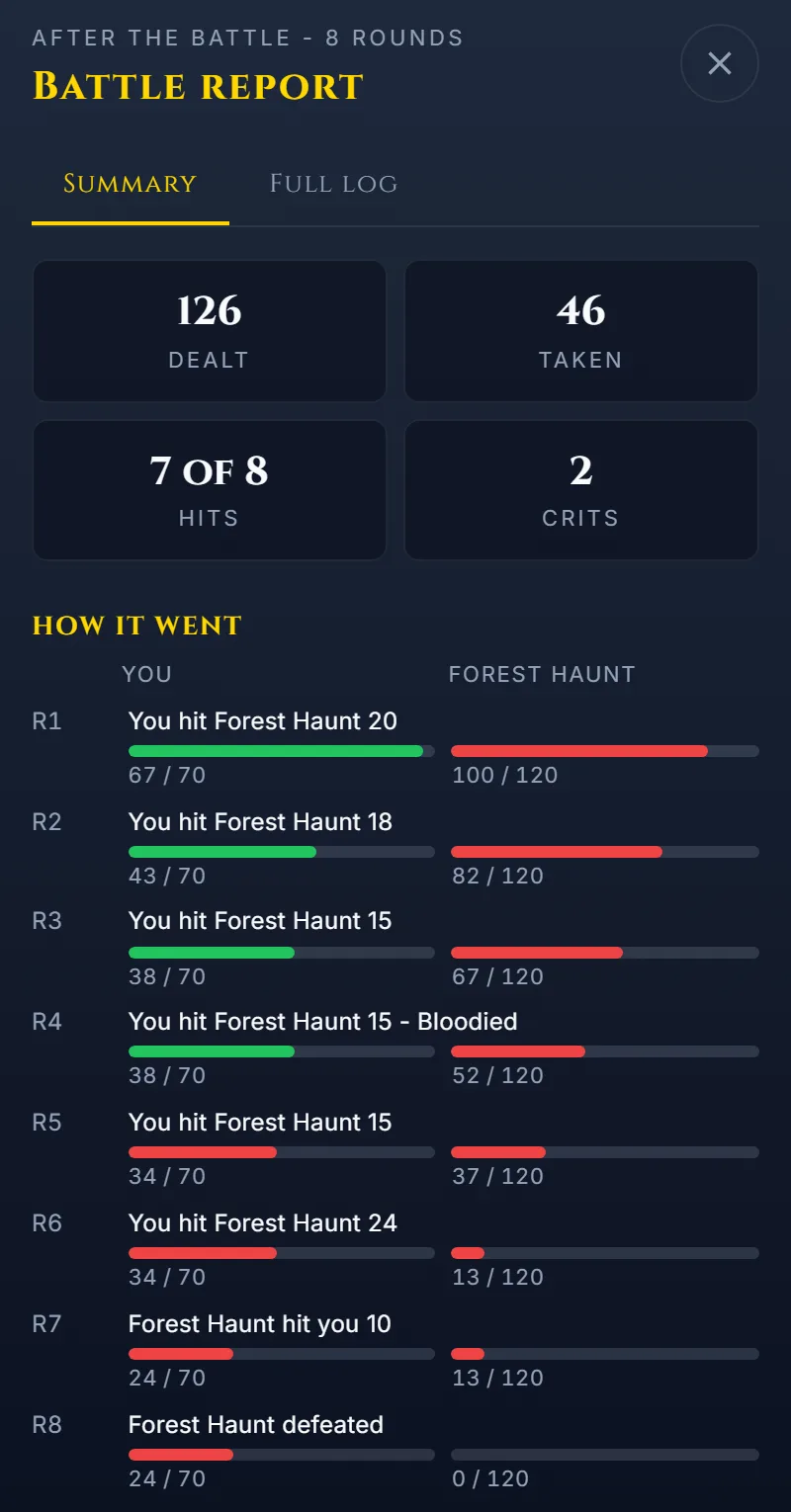
The report fits a narrow screen too: the tiles go two by two and each round's bars sit under its line.
What rules did we set for ourselves?
A log is where a game can quietly turn players against each other, so we wrote down what ours must never do, now and later:
- No damage meters or rankings between heroes. No per-hero dealt, healed or taken columns, even in a party report.
- Your dice are yours. Nobody sees another player's luck.
- No blame lines. A wipe report names monsters, not friends.
- No grades. No MVP, no stars, no performance score, and a defeat is never graded.
- One caption at a time. No stack of pop-ups competing for your eye.
- No "simple mode" that hides the rolls. The roll is the game; our job is to make it easy to read.
What smaller fixes came with it?
- The Turn Order line of a party fight shows a proper arrow between names again, where a garbled character used to sit.
- Plurals read right: "faces 1 enemy!" and "faces 3 enemies!".
- A party turn that runs out of time gets one plain line: the hero's turn timed out.
- "Rounds", not "T5": the end screens, the Full log and the defeat panel all count in rounds.
- The defeat screen's totals and the battle report count damage by one shared rule, so the two always agree.
What comes next for the combat log?
These are plans, not promises with dates. Party adventures are returning to Lourdin RPG one at a time, and before party raids come back we want a raid screen built for them: a feed for your seat beside the board, so the log never covers the fight, a turn tracker in a single row, and panels for a fallen hero that show 5e death saves. After that come more fields from the game engine (the name of every hero's attack and spell on the card, a save's ability such as "WIS 9 vs DC 15", condition durations), a party version of the battle report that keeps the no-ranking rule, and a phone layout for the log itself.
Until then, pin the log beside the board and tap a roll line now and then. The Lourdin RPG combat guide covers turns, attacks and saving throws if you want the rules behind the numbers. If a card ever shows math that does not add up, tell us after the fight through the BETA chip in the game's menu: that is exactly what we want to hear about.